But since there are so many kinds of good deeds, we may get lost and then not end up doing any. For this reason, Shakyamuni Buddha condensed all the good deeds we can possibly do into six categories of virtues. Buddha taught us to do any one of them or even two or more if we’re able to.
In this post, we will learn about the first paramita of Generosity.
This simply means having a charitable mindset toward others but also acting on it. We found out last time the big idea behind Buddhism is for each of us to stop doing evil and to do more good. Being generous toward others is an easy and kind way for us to do this.
 |
| Original Photo by Ed Yourdon available on Flickr.com |
This simply means having a charitable mindset toward others but also acting on it. We found out last time the big idea behind Buddhism is for each of us to stop doing evil and to do more good. Being generous toward others is an easy and kind way for us to do this.
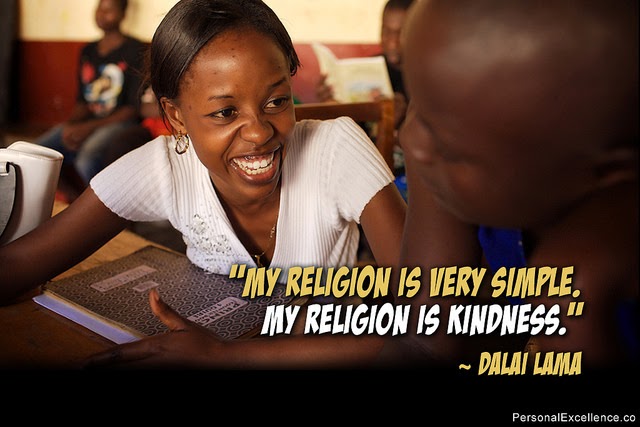 |
| Shared Word Art by Celestine Chua available on Flickr.com |
There are two kinds of giving: Giving Materials or Money and Giving the Teachings of Buddhism. Here we will focus on the first category, Giving Materials or Money. This means helping people and making them happy by giving them something they need. Shakyamuni Buddha taught us that this is a really good thing for us to do for others.
However, it's important to note that the real value of giving does not depend on the amount of money or materials. It is all about the intention behind the giving. Let’s get more insight from this historical Buddhist short story.
***
Once upon a time there was a poor woman called Nanda. One
day she went to listen to Buddha deliver a sermon. The hall was brightly lit
with oil lamps that people from all over town had brought as offerings.
 |
| Original Photo by Geoff Stearns available on Flickr.com |
"Oh, how I wish that I could offer a lamp, but I could never get even close as poor as I am," she pondered. "Hmmm... but there has has to be at least something I can do."
Nanda was filled with resolve but the high price of oil was a hefty challenge.
Nanda was filled with resolve but the high price of oil was a hefty challenge.
Nanda's hair was beautiful, long, and shiny. She decided to sell it in order to raise funds. A compassionate person was willing to buy her locks of hair for a petty amount of money.
With this small windfall, she went straight to an oil seller and asked to buy the oil needed for one lamp.
With this small windfall, she went straight to an oil seller and asked to buy the oil needed for one lamp.
“Let me get this straight, you want to buy oil enough for an entire lamp?” the merchant said sheepishly.
“Don’t waste my time. Look at this change. It just isn’t enough.”
But she begged and pleaded, “Please give me some amount of oil! Anything,
please I beg you.”
The merchant’s heart began to soften, “Sister, tell me the truth. Why would you
want that much oil anyway? You’re poor. I can tell by looking at your clothes made out of rags. You’ve
got much better ways to spend this money. Why not save up for a coat or more food for your family?”
Then Nanda shared with him the reason she needed the oil. It was
so she could offer a lamp to light the hall for the noble Shakyamuni Buddha and his teachings.
"A coat may warm me through cold nights, and more food may help me and my family endure a few more days. But the lectures of Shakyamuni Buddha are timeless and help me understand about the crucial matter of my afterlife."
"A coat may warm me through cold nights, and more food may help me and my family endure a few more days. But the lectures of Shakyamuni Buddha are timeless and help me understand about the crucial matter of my afterlife."
"I see. So this is to make an offering?" the merchant thought for a moment
and looked upon her compassionately. "Well, in that case I’ll give you a special
discount this time."
Nanda was overjoyed, "Oh thank you, kind sir! Thank you so much!"
It was just one little light among many, but it was the very best that
Nanda could offer. Of all the thousand lamps, hers burned the brightest. The
other lamps lasted through the night, but in the morning they all had fizzled out.
Only Nanda’s kept right on shining.
 |
| Original Photo by +rex available on Flickr.com |
Buddha’s disciple Maudgalyayana tried to put it out, but the
wick seemed to keep on relighting. He went to the Buddha to find some kind of an
explanation.
"What could be the meaning of this, Buddha?"
"You lack the power to extinguish the source of that lamp's light," The Buddha
began. "You might even pour the waters of the seven seas on that flame, but it would still
burn on."
***
This sincere donation was all because of the charitable mindset of a poor woman
named Nanda. Even suffering from her own miserable poverty, she managed to offer her very best. This story gives to the saying, "One light from a poor person
outshines the glow of a rich man’s 10,000 lights."
The merit of a gift doesn't depend on its amount. The true abundance of a gift comes from when it is given from all the heart.
So let’s open up our hearts and be generous to others. We must also be just as resourceful as
Nanda was. Sharing what you have will not only bring its own rewards, but it will continue
to shine brightly for you and help light the way through the night.
Here is another historical Buddhist story. This time it is about a rich man who greatly wanted to build a center of Buddhism, but faced tremendous obstacles in order to have it built.
***
During the time of the Buddha, a man by the name of Anathapindika had become delighted listening to the teachings. He greatly wished to build a monastery and so went out on a search to find the perfect spot.
He searched long and hard, but it wasn't long before he stumbled upon a beautiful stretch of forest. It was not too far away from the city, but at the same time it wasn't too close to the center of town to be too hectic. It was a beautiful stretch of land with plenty of nature, and there was no sign of any wild beasts or poisonous snakes.
Upon investigating who owned the land, he discovered that it belonged to King Pasenadi's son, Prince Jeta. Anathapindika scurried over to pay him a visit.
 |
| Original Photo by Scott Wylie available on Flickr.com |
Upon investigating who owned the land, he discovered that it belonged to King Pasenadi's son, Prince Jeta. Anathapindika scurried over to pay him a visit.
"You what?" Prince Jeta shouted. "You want to buy my most prized land?"
"Yes, your highness" replied Anathapindika. "To build a monastery where people can hear the Buddha preach."
"No, no, and no. I do admire your cause, but I'm sorry. It is simply out of the question. That precious land is simply not for sale."
"Please, reconsider..." he begged, overflowing with emotion. "Your highness!! This would be to help spread the wondrous teachings of Buddha."
Prince Jeta replied coolly, "Tears and even your philosophical reasoning won't move me even an inch."
"YOUR HIGHNESS PLEASE!!! But you must understand...!!!"
"Threats won't budge me either. Have you forgotten exactly who it is that I am? Why not just find some other land? There are plenty of others to choose from."
"Because this land is perfect, sire! Surely someone as astute and knowledgeable would easily see the benefit that this could provide..."
"Your charm and praise, though greatly appreciated, won't work either I'm afraid. Please leave my sight at once. That is all."
"But your majesty, I'll do anything!"
At these words, Prince Jeta became intrigued by Anathapindika's persistence.
"All right, all right, all right. Settle down or else I will charge you and your behavior as defiance to the crown!" Prince Jeta said waving his finger authoritatively. "If you really want that land so badly, Anathapindika, I'll give it to you. But you first must cover the entirety of the region that you desire for this temple -- in gold coins! I'll agree to trade you all the land you want in exchange for the gold that you rest upon every square inch of soil."
"But your majesty, I'll do anything!"
At these words, Prince Jeta became intrigued by Anathapindika's persistence.
"All right, all right, all right. Settle down or else I will charge you and your behavior as defiance to the crown!" Prince Jeta said waving his finger authoritatively. "If you really want that land so badly, Anathapindika, I'll give it to you. But you first must cover the entirety of the region that you desire for this temple -- in gold coins! I'll agree to trade you all the land you want in exchange for the gold that you rest upon every square inch of soil."
Anathapindika's face took on a puzzled expression for a moment but then lit up with a smile from ear to ear. "Oh, thank you, Prince Jeta! THANK YOU, YOUR MAJESTY! I'll begin work on it right away, sire--"
"Hey, you know I was really kind of kidding, don't you?" but before Prince Jeta could say another word Anathapindika made haste out of the castle. "Hah! I guess I'll let him try," he said looking over at one of his attendants. "But still he'll never come up with that kind of money. It's impossible."
Anathapindika began calculating all of his assets and found creative ways to stretch his budget.
 |
| Original Photo by Jeff Belmonte available on Flickr.com |
He might just be able to cover the amount of gold needed, but he realized that by including the donations of others it would deepen the bond others have with Buddhism. So he posted signs all over the city asking for donations of any kind to help build, furnish, and supply the monastery. People all over the city began to donate materials and money.
After observing the villagers carrying various items of value away from the city, Prince Jeta ordered one of his attendants to investigate Anathapindika's activities. The attendant quickly returned back to Prince Jeta with a look of complete bewilderment.
"Your majesty," said the attendant in a daze. "That man you received the other day, Anathapindika... well, he is now in the process of spreading gold over your lands at this very moment. I've seen him with my own eyes spreading the gold coins himself. Many of the villagers are even leaving donations for the new temple."
Prince Jeta couldn't believe it. He mounted his horse and rode over to his forest. Sure enough, Anathapindika was at the halfway point spreading gold coins over the land.
"Wait. Stop right there!!" Prince Jeta shouted. Anathapindika stopped to look at the prince. All the villagers turned their eyes toward the prince as well. The prince scanned his land covered in gold and observed all the donations from the villagers. His facial expression slowly became softer.
"Your determination and regard for Buddhism amazes me," said the prince. "Let me contribute the other remaining half of the land as an act of charity to this grand new temple."
"Your determination and regard for Buddhism amazes me," said the prince. "Let me contribute the other remaining half of the land as an act of charity to this grand new temple."
And so Prince Jeta and Anathapindata built together what was to become the famous Jetavana Monastery.
 |
| Original Photo by Photo Dharma available on Flickr.com |
***
But some still might hear this story and think to themselves, "Well, I'm not able to give anything as great as Anathapindika. I'm flat broke. Since I have next to nothing to give, I can't offer anything. And since I can't give like you say, it seems like I'll stay in bad shape."
Again -- what matters most in giving is what's in the heart. Having a heart that wishes to give and share is what is most precious. Even if you have nothing you can give, you can still give many gifts that come from the heart.
In fact, Buddhism teaches there are 7 Ways of Giving for Free.
1.) The Gift of a Warm, Friendly Look -- Welcoming people with your eyes can be a tremendous gift you can give to anyone for free. It lifts the spirits of those around you and gives comfort to
people who may be feeling down. It has been said that eyes are the window to the soul, so show the world a soothing radiance with each glance.
 |
| Original Photo by Ehsan Khakbaz H. available on Flickr.com |
2.) The Gift of a Soothing Expression -- Smiling is another way to share with others a peaceful, easy feeling. Greeting others you meet with that first smile is something truly wonderful to receive and can be done at no cost. When someone gives you a heartfelt smile, it can often ease your suffering and melt away all life's little troubles for a while. It makes you and the other person feel joyful in unison! A little grin can even calm people down, and it promotes harmony. Everyone else will start to get along better and smile by following your example. Instructions to smile: simply pull each corner of your mouth toward your ears and put your teeth on display! Don't be shy!
 |
| Original Photo by Jesse Barker available on Flickr.com |
3.) The Gift of Gentle Words -- Say nice things to people. Give up using sarcasm if possible. It's such a rare blessing to hear words from someone who is speaking from the heart. Whenever we hear someone genuinely sharing warmth, it makes us feel really happy inside. Listen to others and take a sincere interest in their well-being. Offer uplifting support when you reply.
 |
| Shared Word Art by BK available on Flickr.com |
4.) The Gift of Help through One's Effort -- This means really getting down to work by doing physical labor for a friend, a charity, or for society. Use your muscle and get your cardio by lending a helping hand to someone in need. It could be lending a hand during someone's move, opening a door for someone, or picking up something that someone has dropped on the floor.
 |
| Original Photo by Feed My Starving Children available on Flickr.com |
5.) The Gift of Gratitude from the Heart -- This is saying thanks to someone and really meaning it. Not just "Thanks," but "Thank you very much!!" said with gusto and real enthusiasm. Gratitude is a very powerful force. It's contagious and capable of doing very great things for this world.
 |
| Shared Word Art by BK available on Flickr.com |
6.) The Gift of Giving Up Your Spot -- In our lives, we assume various positions and hold onto various entitlements. Giving up your Spot means letting someone else have that treasured parking space. Just be patient and give others the right of way at an intersection rather than speeding ahead. Offer the last seat on the bus or train especially to the elderly or disabled. You can yield your spot as chairman of the board as you retire, or even resist the temptation of your last bite to share it instead. It's not only about giving up your seat; it's about thinking of others first before thinking of yourself.
 |
| Original Photo by isa available on Flickr.com |
7.) The Gift of Sharing a Meal and Offering a Night's Stay -- This means to offer someone in the middle of a difficult journey in life a meal and a place to spend the night. When another is in a time of great twists and turns along their path, this can be a very precious, comforting gift. Most of us have a little bit extra in the fridge and how better to use it than to help out a friend in need. So clear off the couch and freshen the linens in the extra bedroom!
 |
| Shared Word Art by BK available on Flickr.com |
These are all things we can do anywhere and at any time and without any cost to us. All we have to do is try it and it is sure to work! These efforts we do for others are rewarding to us because of the Law of Cause and Effect.
Good deeds bring good results.
Bad deeds bring bad results.
Your own deeds bring your own results.
Our actions are what decide our fate. That's why it's so important to do as much good as we can for others all the time. We can only benefit from it!
So let's go out there and use kind words and avoid all that negativity, criticism, and insulting language. Instead be nurturing, considerate and caring with your friends and family. Try to focus on giving from your heart as well as smiling a little bit more throughout life.

 |
| Original Word Art by Celestia Chua available on Flickr.com |
So let's go out there and use kind words and avoid all that negativity, criticism, and insulting language. Instead be nurturing, considerate and caring with your friends and family. Try to focus on giving from your heart as well as smiling a little bit more throughout life.
In the next post, we will learn the importance of who we should give our best effort to. Just as important as it is to plant good seeds, it is also important to know the best place to maximize our efforts.
-----------------------------------------------------------------------------------------------------------------------------
Note: The translation of Śākyamuni has many different spellings. Up to this point, Sakyamuni has been used, which was the phonetic translation without accent symbols. In order to come closer to the original sound, Shakyamuni will now be used. Both forms are still acceptable, but this alternate spelling is preferred. Soon past posts will all be updated to reflect this change.
-----------------------------------------------------------------------------------------------------------------------------
Note: The translation of Śākyamuni has many different spellings. Up to this point, Sakyamuni has been used, which was the phonetic translation without accent symbols. In order to come closer to the original sound, Shakyamuni will now be used. Both forms are still acceptable, but this alternate spelling is preferred. Soon past posts will all be updated to reflect this change.


