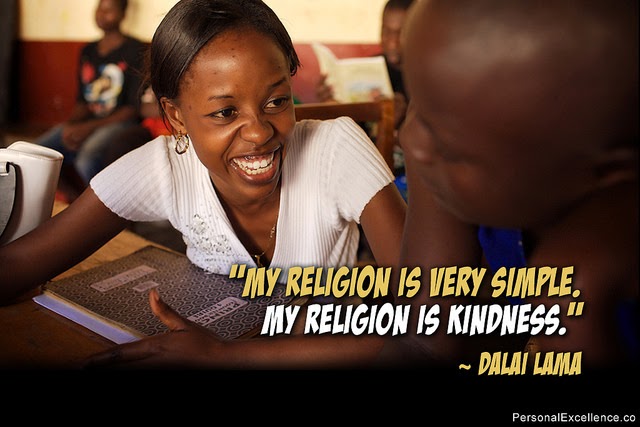
Showing posts with label kindness. Show all posts

Monday, September 8, 2014

Generosity - Sharing the Dharma with Family & Friends

          Up to this point, we've discussed the first paramita of generosity.

          Donating materials or money when it is given deeply from the heart greatly contributes to our overall happiness and well-being as well as to those around us.

           We also learned about seven special ways that we can give for free on a daily basis. Here's a little recap:


Seven Good Deeds that Don't Cost Anything

1.) Having a kind, warm look in our eyes

2.) Smiling as best we can authentically

3.) Speaking with compassion & using the gentlest wordings

4.) Lending a hand & using our physical efforts to help people

5.) Expressing our gratitude with feeling & showing respect to others

6.) Giving up our seat or letting someone else go first

7.) Sharing a meal or opening up our home for someone who is in distress


          And lastly, we found out that we get the most of our donations and kind acts when we give them wisely in each of the Three Fields: Those We Respect, Those We're Grateful Toward, and Those in Desperate Need of Compassion.

          Now moving forward, the second category of generosity is Sharing the Teachings of Buddhism. This means to share what you've learned from the Dharma with the people of your life. 

          Giving the gift of Buddhism is in itself the very best way we can practice and give kindness. And now thanks to modern technology, we can even conveniently share it with anyone online!

          As we ourselves continue to listen to Buddhism, we learn more and more about who we really are gradually. Often times what we find out about ourselves can be very difficult to come to accept.

          But if we endeavor to push forward and keep seeking, we can and will attain absolute happiness -- all at once in just one split-second moment -- and, simultaneously discover our True Self at the same time.


Original Graphic by Paul Inkles available on Flickr.com

          Our purpose in life is to successfully obtain this once-in-a-lifetime experience of "WOW!" for ourselves and to then live on in gratitude and celebration of achieving eternal happiness. 

          We were born as human beings for the sole purpose of experiencing this blissful feeling like none other. In, Buddhism, it is also known as the Path of No Hindrance

          We guide others toward obtaining this spiritual liberation by sharing the Buddha's teachings with kindly words and comforting smiles. Our personal opinions and objections get placed aside when we share. We hold back our own desires to make quick value judgements or to share personal opinions. Priority is given to the guidance that is found within the teachings in order to help others find the right way. 

          To share Buddhism with others effectively, we must first learn how to truly listen to others deeply. We have to carefully understand and examine the other person's state of mind and condition before we begin sharing the Dharma. 

          By listening to others fully, we gain wisdom and learn about situations that we ourselves might face in the future. 


Original Comic by James Clayton available on Flickr.com

           Sharing Buddhism also develops our own capacity to have patience and compassion.

          Now the importance behind why we seek after the teachings is that we are facing a grave problem... literally. 

           There is only a limited amount of time for us here on Earth, and precious time is constantly ticking away night and day. All of us have this very crucial matter of mortality to face and solve, all while we're still alive.

         The teachings of Buddhism reveal to us a truth that is very difficult to hear or find anywhere else addressed in this same way. One Buddhist master by the name of Shinran used these words, "This world is as fleeting and unstable as a burning house." This doesn't paint a pretty picture for where we live.

          Though there is something we can all do about it, many of us choose to ignore the problem and put it off to some other time. Yet the thing we procrastinate the most about is our own impending death.

           Even when we hear about death occurring on the news, we all keep trying to live life to the fullest despite what we hear. We want to remain ignorant that death is coming up for us too. We sweep that problem under the rug for as long as we can, out of sight and out of mind. 

            But the more we try to run and hide, the more we come to find that all those worldly pursuits of happiness we fight so hard for every single day... keep letting us down again and again.  

             It's because all those worldly pleasures aren't capable of lasting in the first place.

             If we just pursue the good times relentlessly and do achieve fame and fortune, we are still inching closer and closer to the final moment of death. Ignorance is not bliss in the long run. Death happens suddenly and without notice to every person on the planet.

            We never know when that last moment will strike for us. But it's really coming for me one day, and it's really coming one day for you too. It is scary. I know.

             That's exactly why sharing Dharma is thus the most precious gift we can offer ourselves or others while our life force still remains strong. Being born a human being gives us this tremendous opportunity to uncover our True Self. Knowing who we are is a kind of bliss that we've never known for uncountable aeons past. Now, finally, we can obtain it.

But with more than 7,000 sutras to study, this is no easy task.

               That's why it's so important for us to find a good teacher who can guide our understanding of the Buddha's words. By observing and listening to true Buddhist teachers directly at a Buddhist center, you can learn about the Dharma in the best way.

          Then when you decide to share Buddhism on your own, you can invite the people closest to you over to your home for a spiritual chat. Here and there, you can bring up Buddhism in conversation whenever and wherever you feel that it is comfortable to do so. If you want to form a study group, you can hold a talk at a library, cafe, or public space that is suitable for study.

           When Buddhism becomes a big part of your life, it is because you are moved deeply to discover your purpose of life. You realize that there is this very grand endeavor we all have in our lives. We are all born for this reason. 

          And then when you attain it and feel that true happiness inside yourself, you can't just keep such a profound feeling of peacefulness all to your lonesome. If you actually find the meaning of life, you must of course share that wisdom with all your family, friends, and loved ones. And the world even!

          Imagine for a moment that you go to a very delicious and famous Italian restaurant. You order a pizza there, but up until your first bite, you couldn't believe all those rave reviews you read online. "No pizza can taste that delicious," you think to yourself. But everyone kept going on and on about how wonderful the pizza tastes there. It makes you start to wonder. But you can't really know whether that pizza is delicious or not until you actually go there, order it, and take a bite.


Original Photo by Ragdoll available on Flickr.com
  
         That first mouthful represents that split-second moment that reveals to you just how great the flavor really is! Wow!

           The first thing you'd do is spread the word to all your friends, "Hey, you gotta go to this pizza place and try it! I'm serious. I thought all the people were exaggerating, but now I know better. You won't believe how good it is until you try it."

           You'd want everybody to share in the same wonderful experience you just had. Likewise, when we experience a real sense of contentment from the wisdom of the Buddha's teachings, we also can't wait to share that joy we found with those closest to us.

            Sharing Buddhism begins with finding one person -- YOURSELF!

           Once you begin to discover more about your True Self, you will develop a stronger karmic connection with Buddhism. Over time, you will then naturally develop a wish to share with others. But it's totally up to you and your own discretion.

           If you do talk to your family and friends about the Dharma, you will find out all the little gaps in your own understanding. (I'm still learning every day even as I try to write this blog.)

           Sharing Buddhism with others begins by talking wholeheartedly with just one person at a time. Even though there are so many people in the world in desperate need of the truth, the spread of truth begins patiently and accurately with one person. We give our all to them and share as best we can in each lesson. By focusing on teaching to this one individual, gradually our knowledge base and experience will expand, and we can be able to share with larger groups.

            It's very important to have empathy for the feelings of those who follow a different sect of Buddhism or a different religion altogether. Learn from them as well as teach them. But keep in mind that every religion or spiritual group has its own different idea about where our path in life leads. Sometimes, putting it all together and finding the right one can be confusing. But this is an important task you must decide for yourself.


Original Photo by EnKayTee available on Flickr.com

          At the beginning, we are still making up our minds, and we may need time to find our exact spiritual direction. But when we know that we wish to dedicate ourselves and follow the Pure Land path, we then become mindful of continuing on the course that is taught so we can reach the finish line as soon as possible.

           We want in our hearts to bring everyone toward happiness, but ultimately the choice is up to every person to make. Teach with the most energy to those open-minded persons who express a real thirst for the teachings.

           Remember, the Dharma is not something that can be forced or pushed onto someone. Each person must find the truth at their pace. We can only wish in our hearts that everyone obtain absolute happiness quickly.

            And when teaching, it's better to find a person's question accurately from a Buddhist teacher than to answer incompletely or in a round-about kind of way. You may be answering incorrectly if you do so. We must guide people in the right direction, first and foremost.

            That's why we make our best effort to encourage others to visit a Pure Land Buddhist center. This is the best place for us to directly learn the teachings. Once there, we can learn in the best way how to share the teachings. By visiting a Buddhist center or meeting with Buddhist friends, we can all find the answers to our innermost questions together.

           It's been said that, "Material weath may be treasure for a lifetime, but the Dharma is a treasure for all eternity." Money and possessions can only bring us temporary pleasure while we're alive in this world. Once we die, we must leave behind all our treasures, our possessions, and... even our loved ones. We must go it all alone.

        This sad fact is what makes death so very difficult and painful for all of us. This world is the only home we've come to know. At death, we must leave with nothing.

        For all these reasons, death is our most crucial matter to solve. It's also why a sensitivity to the nature of how all things are impermanent is essential in Buddhism.

         Without this inclination, people remain focused only on the pleasures of life until they get old, sick, or die. People worry a great deal about having enough money for their retirements, but that's only an issue if you live that long. Old age is not guaranteed. Death is what's certain.


Original Photo by ~C4Chaos ~C4無秩序 available at Flickr.com

          Having a keen sense of impermanence drives us to make continual efforts toward studying the teachings. It pushes us to listen more carefully so that we can find out once and for all who we really are on this journey... BEFORE it's too late and death comes knocking for us.

          Even if we forget all about our own death and become overly consumed with worldly desires, we will still lose those closest to us sooner or later. And so we are reminded again but in a way that hits us so deeply we can't deny it any longer.

         It has been said that we cry the most at funerals because we're crying two times -- once for the person who has left us, and once for ourselves because we too must go one day. 


"Ties in this world last only for a time.

We are husband and wife,
 
parent and child

for a short period only.

Once this reality sinks in,

we cannot help treasuring

each moment

of our brief association."


-Takamori Kentetsu


          Listening to Buddhism leads us toward finally attaining our one and only purpose in this life, to attain that everlasting, constant, thriving joy inside us. It's not something we get after we die. We must discover it in this lifetime while we're still alive. 

         Once we have finished this momentous accomplishment of life, we simultaneously discover our eternal self at long last. For it is only when we know ourselves that we can be truly happy.

          The gift of Buddhist truth is the most precious gift of all because it has the power to dispel the darkness of our anxious minds surrounding the issue of where go in the afterlife. It clearly illuminates once and for all -- while still living -- what happens to us after this life fades away. Imagine the peace of mind knowing that.

          Once this wisdom is known to us with 100% certainty, we experience what's known in Buddhism as the level of true settlement. This level of true settlement is the 51st level of enlightenment. We live the remaining course of our natural lives still full of all the worldly passions that come with being human. But when one who has attained the level of true settlement dies, they are then granted Nirvana, or what known as the 52nd level of enlightenment. This is the highest level of enlightenment. 

          That's when we are reborn as a Buddha in a blissful world known as the Pure Land of Amida Buddha. Once there, we become a buddha. Then in our own time, we choose to leave the Pure Land and return to this suffering world and other worlds like it as buddhas in order to guide others to absolute happiness. Unlike humans, however, buddhas possess the faculties of perfect wisdom and compassion.

          It is through the Buddha's great wisdom that we are guided to understand, once and for all, the meaning of this unique, precious, often turbulent journey as a human being. We realize the true wonder behind being human. It's a blissful, shimmering experience that makes us want to yell from a mountaintop, "WOW! How wonderful and blessed I am to have been born human! I am the happiest person in the universe!"

            And even with this joyous expression, the fulfillment of such an absolute form of happiness cannot be fully described, for it is an experience which is beyond words and even human understanding.

            Once absolute truth is finally realized within us, the preciousness of Buddhist wisdom becomes completely crystal clear. That's when we know where we are going in the afterlife without a shadow of a doubt, and we know ourselves completely, through and through. 


Original Word Art by Celestine Chua available on Flickr.com


              Of all the wisdom out there, the teachings of Pure Land Buddhism are the very best gift we can provide to anyone, because these teachings contain within them the supreme truth that guides all humanity equally to absolute happiness without any discrimination whatsoever.

             So I wish to share with you now all the links and resources that have guided me thus far on my own quest. By learning deeply from this knowledge yourself, you will then be able to advise others freely as you wish.

***

MIRROR OF DHARMA BLOG


Of course, don't forget to promote this website, mirrorofdharma.org.


                             This concludes the paramita of generosity. Check in next time when we move on to learn more about the rest of the Six Paramitas.

Monday, June 30, 2014

Generosity -- Give the Most from the Heart

              In the last lesson, we learned that the Six Paramitas are Generosity, Accountability, Patience, Effort, Contemplation, and WisdomTo review, the word paramita means virtue in ancient Sanskrit. These virtues act as bridges toward obtaining absolute happiness.

                But since there are so many kinds of good deeds, we may get lost and then not end up doing any. For this reason, Shakyamuni Buddha condensed all the good deeds we can possibly do into six categories of virtues. Buddha taught us to do any one of them or even two or more if we’re able to.

               In this post, we will learn about the first paramita of Generosity.


Original Photo by Ed Yourdon available on Flickr.com


               This simply means having a charitable mindset toward others but also acting on it. We found out last time the big idea behind Buddhism is for each of us to stop doing evil and to do more good. Being generous toward others is an easy and kind way for us to do this.


Shared Word Art by Celestine Chua available on Flickr.com


               There are two kinds of giving:  Giving Materials or Money and Giving the Teachings of Buddhism. Here we will focus on the first category, Giving Materials or Money. This means helping people and making them happy by giving them something they need. Shakyamuni Buddha taught us that this is a really good thing for us to do for others.

                    However, it's important to note that the real value of giving does not depend on the amount of money or materials. It is all about the intention behind the giving. Let’s get more insight from this historical Buddhist short story.


***

                 Once upon a time there was a poor woman called Nanda. One day she went to listen to Buddha deliver a sermon. The hall was brightly lit with oil lamps that people from all over town had brought as offerings.


Original Photo by Geoff Stearns available on Flickr.com

                 "Oh, how I wish that I could offer a lamp, but I could never get even close as poor as I am," she pondered. "Hmmm... but there has has to be at least something I can do."

                 Nanda was filled with resolve but the high price of oil was a hefty challenge. 

                 Nanda's hair was beautiful, long, and shiny. She decided to sell it in order to raise funds. A compassionate person was willing to buy her locks of hair for a petty amount of money.

                 With this small windfall, she went straight to an oil seller and asked to buy the oil needed for one lamp.

                  “Let me get this straight, you want to buy oil enough for an entire lamp?” the merchant said sheepishly. “Don’t waste my time. Look at this change. It just isn’t enough.”

                  But she begged and pleaded, “Please give me some amount of oil! Anything, please I beg you.”
                  The merchant’s heart began to soften, “Sister, tell me the truth. Why would you want that much oil anyway? You’re poor. I can tell by looking at your clothes made out of rags. You’ve got much better ways to spend this money. Why not save up for a coat or more food for your family?”

                 Then Nanda shared with him the reason she needed the oil. It was so she could offer a lamp to light the hall for the noble Shakyamuni Buddha and his teachings.

                  "A coat may warm me through cold nights, and more food may help me and my family endure a few more days. But the lectures of Shakyamuni Buddha are timeless and help me understand about the crucial matter of my afterlife."

                 "I see. So this is to make an offering?" the merchant thought for a moment and looked upon her compassionately. "Well, in that case I’ll give you a special discount this time."

                 Nanda was overjoyed, "Oh thank you, kind sir! Thank you so much!"
                 It was just one little light among many, but it was the very best that Nanda could offer. Of all the thousand lamps, hers burned the brightest. The other lamps lasted through the night, but in the morning they all had fizzled out. Only Nanda’s kept right on shining.


Original Photo by +rex available on Flickr.com


                  Buddha’s disciple Maudgalyayana tried to put it out, but the wick seemed to keep on relighting. He went to the Buddha to find some kind of an explanation.

                  "What could be the meaning of this, Buddha?"

                   "You lack the power to extinguish the source of that lamp's light," The Buddha began. "You might even pour the waters of the seven seas on that flame, but it would still burn on."

***

                   This sincere donation was all because of the charitable mindset of a poor woman named Nanda. Even suffering from her own miserable poverty, she managed to offer her very best. This story gives to the saying, "One light from a poor person outshines the glow of a rich man’s 10,000 lights."

                    The merit of a gift doesn't depend on its amount. The true abundance of a gift comes from when it is given from all the heart.

                    So let’s open up our hearts and be generous to others. We must also be just as resourceful as Nanda was. Sharing what you have will not only bring its own rewards, but it will continue to shine brightly for you and help light the way through the night. 

                    Here is another historical Buddhist story. This time it is about a rich man who greatly wanted to build a center of Buddhism, but faced tremendous obstacles in order to have it built. 

***

                    During the time of the Buddha, a man by the name of Anathapindika had become delighted listening to the teachings. He greatly wished to build a monastery and so went out on a search to find the perfect spot.

                     He searched long and hard, but it wasn't long before he stumbled upon a beautiful stretch of forest. It was not too far away from the city, but at the same time it wasn't too close to the center of town to be too hectic. It was a beautiful stretch of land with plenty of nature, and there was no sign of any wild beasts or poisonous snakes. 

 
Original Photo by Scott Wylie available on Flickr.com


                    Upon investigating who owned the land, he discovered that it belonged to King Pasenadi's son, Prince Jeta. Anathapindika scurried over to pay him a visit.

                    "You what?" Prince Jeta shouted. "You want to buy my most prized land?"

                     "Yes, your highness" replied Anathapindika. "To build a monastery where people can hear the Buddha preach."

                     "No, no, and no. I do admire your cause, but I'm sorry. It is simply out of the question. That precious land is simply not for sale."

                      "Please, reconsider..." he begged, overflowing with emotion. "Your highness!! This would be to help spread the wondrous teachings of Buddha."

                       Prince Jeta replied coolly, "Tears and even your philosophical reasoning won't move me even an inch."

                        "YOUR HIGHNESS PLEASE!!! But you must understand...!!!"

                         "Threats won't budge me either. Have you forgotten exactly who it is that I am? Why not just find some other land? There are plenty of others to choose from."

                        "Because this land is perfect, sire! Surely someone as astute and knowledgeable would easily see the benefit that this could provide..."

                         "Your charm and praise, though greatly appreciated, won't work either I'm afraid. Please leave my sight at once. That is all." 

                         "But your majesty, I'll do anything!"

                          At these words, Prince Jeta became intrigued by Anathapindika's persistence. 

                           "All right, all right, all right. Settle down or else I will charge you and your behavior as defiance to the crown!" Prince Jeta said waving his finger authoritatively. "If you really want that land so badly, Anathapindika, I'll give it to you. But you first must cover the entirety of the region that you desire for this temple -- in gold coins! I'll agree to trade you all the land you want in exchange for the gold that you rest upon every square inch of soil."
                          Anathapindika's face took on a puzzled expression for a moment but then lit up with a smile from ear to ear. "Oh, thank you, Prince Jeta! THANK YOU, YOUR MAJESTY! I'll begin work on it right away, sire--"

                           "Hey, you know I was really kind of kidding, don't you?" but before Prince Jeta could say another word Anathapindika made haste out of the castle. "Hah! I guess I'll let him try," he said looking over at one of his attendants. "But still he'll never come up with that kind of money. It's impossible."

                            Anathapindika began calculating all of his assets and found creative ways to stretch his budget. 


Original Photo by Jeff Belmonte available on Flickr.com

                              He might just be able to cover the amount of gold needed, but he realized that by including the donations of others it would deepen the bond others have with Buddhism. So he posted signs all over the city asking for donations of any kind to help build, furnish, and supply the monastery. People all over the city began to donate materials and money.

                            After observing the villagers carrying various items of value away from the city, Prince Jeta ordered one of his attendants to investigate Anathapindika's activities. The attendant quickly returned back to Prince Jeta with a look of complete bewilderment.

                              "Your majesty," said the attendant in a daze. "That man you received the other day, Anathapindika... well, he is now in the process of spreading gold over your lands at this very moment. I've seen him with my own eyes spreading the gold coins himself. Many of the villagers are even leaving donations for the new temple."

                               Prince Jeta couldn't believe it. He mounted his horse and rode over to his forest. Sure enough, Anathapindika was at the halfway point spreading gold coins over the land.

                                 "Wait. Stop right there!!" Prince Jeta shouted. Anathapindika stopped to look at the prince. All the villagers turned their eyes toward the prince as well. The prince scanned his land covered in gold and observed all the donations from the villagers. His facial expression slowly became softer.  

                                   "Your determination and regard for Buddhism amazes me," said the prince. "Let me contribute the other remaining half of the land as an act of charity to this grand new temple."

                                  And so Prince Jeta and Anathapindata built together what was to become the famous Jetavana Monastery.


Original Photo by Photo Dharma available on Flickr.com

***

                                  But some still might hear this story and think to themselves, "Well, I'm not able to give anything as great as Anathapindika. I'm flat broke. Since I have next to nothing to give, I can't offer anything. And since I can't give like you say, it seems like I'll stay in bad shape."

                                   Again -- what matters most in giving is what's in the heart. Having a heart that wishes to give and share is what is most precious. Even if you have nothing you can give, you can still give many gifts that come from the heart. 


In fact, Buddhism teaches there are 7 Ways of Giving for Free.


1.) The Gift of a Warm, Friendly Look --  Welcoming people with your eyes can be a tremendous gift you can give to anyone for free. It lifts the spirits of those around you and gives comfort to people who may be feeling down. It has been said that eyes are the window to the soul, so show the world a soothing radiance with each glance.


Original Photo by Ehsan Khakbaz H. available on Flickr.com


2.) The Gift of a Soothing Expression -- Smiling is another way to share with others a peaceful, easy feeling. Greeting others you meet with that first smile is something truly wonderful to receive and can be done at no cost. When someone gives you a heartfelt smile, it can often ease your suffering and melt away all life's little troubles for a while. It makes you and the other person feel joyful in unison! A little grin can even calm people down, and it promotes harmony. Everyone else will start to get along better and smile by following your example. Instructions to smile: simply pull each corner of your mouth toward your ears and put your teeth on display! Don't be shy!


Original Photo by Jesse Barker available on Flickr.com


3.) The Gift of Gentle Words -- Say nice things to people. Give up using sarcasm if possible. It's such a rare blessing to hear words from someone who is speaking from the heart. Whenever we hear someone genuinely sharing warmth, it makes us feel really happy inside. Listen to others and take a sincere interest in their well-being. Offer uplifting support when you reply. 


Shared Word Art by BK available on Flickr.com


4.) The Gift of Help through One's Effort -- This means really getting down to work by doing physical labor for a friend, a charity, or for society. Use your muscle and get your cardio by lending a helping hand to someone in need. It could be lending a hand during someone's move, opening a door for someone, or picking up something that someone has dropped on the floor. 


Original Photo by Feed My Starving Children available on Flickr.com


5.) The Gift of Gratitude from the Heart -- This is saying thanks to someone and really meaning it. Not just "Thanks," but "Thank you very much!!" said with gusto and real enthusiasm. Gratitude is a very powerful force. It's contagious and capable of doing very great things for this world.   

Shared Word Art by BK available on Flickr.com


6.) The Gift of Giving Up Your Spot -- In our lives, we assume various positions and hold onto various entitlements. Giving up your Spot means letting someone else have that treasured parking space. Just be patient and give others the right of way at an intersection rather than speeding ahead. Offer the last seat on the bus or train especially to the elderly or disabled. You can yield your spot as chairman of the board as you retire, or even resist the temptation of your last bite to share it instead. It's not only about giving up your seat; it's about thinking of others first before thinking of yourself. 

Original Photo by isa available on Flickr.com

7.) The Gift of Sharing a Meal and Offering a Night's Stay -- This means to offer someone in the middle of a difficult journey in life a meal and a place to spend the night. When another is in a time of great twists and turns along their path, this can be a very precious, comforting gift. Most of us have a little bit extra in the fridge and how better to use it than to help out a friend in need. So clear off the couch and freshen the linens in the extra bedroom!


Shared Word Art by BK available on Flickr.com

                      These are all things we can do anywhere and at any time and without any cost to us. All we have to do is try it and it is sure to work! These efforts we do for others are rewarding to us because of the Law of Cause and Effect.


Good deeds bring good results.

Bad deeds bring bad results.

Your own deeds bring your own results.


                        Our actions are what decide our fate. That's why it's so important to do as much good as we can for others all the time. We can only benefit from it!


Original Word Art by Celestia Chua available on Flickr.com

                        So let's go out there and use kind words and avoid all that negativity, criticism, and insulting language. Instead be nurturing, considerate and caring with your friends and family. Try to focus on giving from your heart as well as smiling a little bit more throughout life. 


                        In the next post, we will learn the importance of who we should give our best effort to. Just as important as it is to plant good seeds, it is also important to know the best place to maximize our efforts. 

-----------------------------------------------------------------------------------------------------------------------------
Note: The translation of Śākyamuni has many different spellings. Up to this point, Sakyamuni has been used, which was the phonetic translation without accent symbols. In order to come closer to the original sound, Shakyamuni will now be used. Both forms are still acceptable, but this alternate spelling is preferred. Soon past posts will all be updated to reflect this change.